Attention Deficit Disorders (ADD/ADHD) in Children
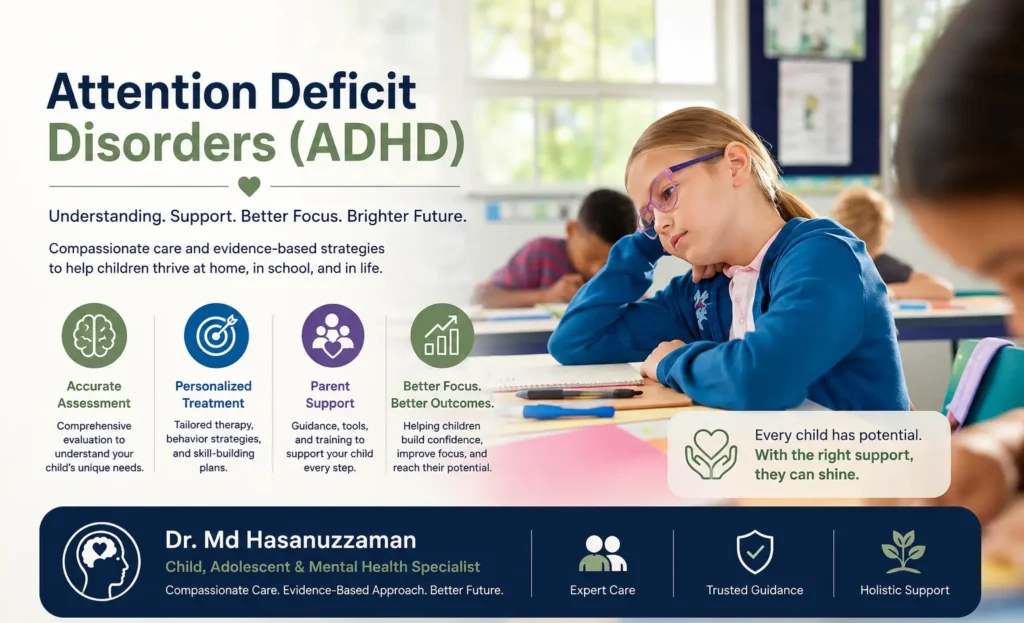
A child who forgets instructions, loses school materials, struggles to finish homework, or cannot remain seated is not necessarily careless or disobedient. Persistent problems with attention, organization, hyperactivity, or impulse control may sometimes be associated with Attention-Deficit/Hyperactivity Disorder, commonly known as ADHD.
The older term ADD, or Attention Deficit Disorder, is still commonly used when a child mainly experiences inattentiveness without obvious hyperactivity. However, ADHD is the current clinical term and may involve predominantly inattentive, predominantly hyperactive-impulsive, or combined features.
At Homeo Care, Dr. Md. Hasanuzzaman provides individualized consultations for children experiencing attention, learning, behavioral, sleep, nutritional, and developmental concerns. Consultations are available at Homeo Care Dhaka, Homeo Care Jessore, and through online appointments when appropriate.
The objective is not to label a child after a brief conversation. It is to understand the child’s health, development, family environment, learning experience, daily habits, and emotional wellbeing—and to guide the family toward appropriate professional support.
Important clinical point: ADHD cannot be confirmed through a single laboratory test, scan, or observation. Diagnosis requires a structured assessment, and several other conditions can produce similar symptoms.
Article Reviewed by Dr. Md. Hasanuzzaman
Dr. Md. Hasanuzzaman
DHMS (Dhaka)
BHMS (DU Apprentice)
PG Hom. (London)
MPH in Nutrition
Registered Homeopathic Physician
Clinical Nutritionist and Medical Educator
Lecturer in Physiology
More than 14 years of clinical experience
Dr. Md. Hasanuzzaman works with children and families through a person-centered approach that considers physical health, nutrition, sleep, behavior, emotional wellbeing, development, and family circumstances.
When a child’s symptoms suggest ADHD, a learning disorder, developmental difficulty, or mental health condition, referral to an appropriately qualified pediatric, developmental, psychological, or psychiatric professional may also be recommended.
What Is ADHD in Children?
ADHD is a neurodevelopmental condition associated with a persistent pattern of:
- Inattention
- Hyperactivity
- Impulsivity
These difficulties must be more significant than expected for the child’s developmental stage and must interfere with everyday functioning, such as schoolwork, family routines, friendships, or personal independence.
A child may have attention difficulties without being visibly hyperactive. Another child may be highly active and impulsive but have fewer obvious concentration problems. Some children experience both groups of symptoms.
Clinical guidelines emphasize that ADHD assessment should consider the child’s functioning and behavior across different settings, including home and school. Information from parents, caregivers, teachers, and other relevant professionals may therefore be necessary.
Is ADD Different From ADHD?
Parents often search for both ADD in children and ADHD in children.
ADD was previously used to describe attention difficulties without marked hyperactivity. Today, these concerns are generally considered under the broader diagnosis of ADHD, particularly the predominantly inattentive presentation.
A child with mainly inattentive features may appear:
- Quiet or withdrawn
- Frequently lost in thought
- Forgetful
- Disorganized
- Slow to begin or complete tasks
- Easily distracted
- Unable to follow longer instructions
Because these children may not disturb the classroom, their difficulties can sometimes remain unnoticed for longer than those of children who are visibly restless or impulsive.
Common Signs of Attention Difficulties in Children
Parents or teachers may notice that a child:
- Makes frequent careless mistakes
- Has difficulty maintaining attention during study or play
- Appears not to listen when spoken to directly
- Starts tasks but does not complete them
- Frequently loses books, pencils, toys, or school materials
- Forgets homework, instructions, or daily responsibilities
- Finds it difficult to organize activities
- Avoids tasks that require sustained mental effort
- Becomes distracted by sounds, movements, or surrounding activities
- Daydreams excessively
- Has difficulty waiting for a turn
- Interrupts conversations or classroom activities
- Acts without considering the consequences
- Fidgets, runs, climbs, or moves excessively
- Struggles to remain seated when expected
- Becomes emotionally frustrated by ordinary tasks
- Performs below expectations despite having adequate intelligence
One or two of these behaviors do not confirm ADHD. Many children occasionally become distracted, restless, or forgetful, especially when tired, stressed, hungry, anxious, or uninterested in a task.
The pattern becomes more concerning when symptoms are persistent, developmentally inappropriate, present in more than one environment, and interfere with the child’s daily life.
Not Every Inattentive Child Has ADHD
There is no single test that can independently diagnose ADHD. Sleep disorders, anxiety, depression, learning disabilities, and several other health or developmental concerns may produce similar symptoms.
Possible alternative or contributing factors include:
Sleep difficulties
Late sleeping, irregular routines, snoring, poor-quality sleep, or inadequate sleep can affect concentration, mood, memory, and behavior.
Learning disorders
A child may avoid reading, writing, or mathematics because the work is genuinely difficult—not because the child is unwilling to concentrate.
Anxiety or emotional distress
Fear, family conflict, bullying, academic pressure, grief, or other stressful experiences can make it difficult for a child to focus.
Hearing or vision problems
A child who cannot clearly hear a teacher or see classroom materials may appear inattentive or uncooperative.
Nutritional and dietary concerns
Irregular meals, inadequate nutrition, excessive reliance on highly processed foods, or nutritional deficiencies may affect energy, sleep, and general wellbeing. However, diet alone should not be assumed to be the cause of ADHD.
Developmental differences
Language delays, autism spectrum conditions, intellectual difficulties, sensory processing concerns, and other developmental conditions may influence attention or behavior.
Medical conditions or medicines
Some medical problems, seizures, thyroid-related conditions, medication effects, and other health factors may require consideration based on the child’s history.
This is why professional assessment should focus on the complete child rather than on one isolated symptom.
When Should Parents Seek Professional Advice?
Parents should consider seeking professional advice when attention, activity, or behavioral difficulties:
- Continue for several months
- Are seen both at home and at school
- Affect academic progress
- Disrupt daily family routines
- Cause repeated conflict with teachers, parents, or siblings
- Interfere with friendships
- Reduce the child’s confidence
- Lead to frequent punishment without improvement
- Create safety concerns because of impulsive behavior
- Occur alongside learning, language, sleep, or developmental difficulties
Immediate professional support is especially important if a child shows severe emotional distress, talks about self-harm, becomes unusually aggressive, experiences a major loss of functioning, or has episodes that may represent seizures or another urgent medical condition.
Why Early Assessment Matters
Unrecognized attention difficulties can affect more than examination results.
Over time, a child may begin to believe that they are lazy, unintelligent, or “bad.” Repeated criticism can reduce motivation and self-esteem, even when the child is genuinely trying.
Persistent difficulties may affect:
- Reading, writing, and classroom learning
- Homework completion
- Time management and organization
- Relationships with parents and teachers
- Friendships and social participation
- Emotional regulation
- Confidence and independence
- Family routines and stress levels
Early recognition does not mean placing a permanent label on the child. It allows parents and professionals to understand the child’s needs and introduce appropriate support before frustration becomes more severe.
How ADHD Is Professionally Assessed
A proper ADHD assessment is a multi-step process. It may include:
- A detailed developmental and medical history
- Discussion with the child and parents
- Reports from teachers or caregivers
- Assessment of behavior in more than one setting
- Review of academic and learning difficulties
- Evaluation of sleep, hearing, vision, mood, and anxiety
- Consideration of developmental or coexisting conditions
- Standardized questionnaires or rating scales when appropriate
- Referral for psychological, developmental, or psychiatric evaluation when indicated
The American Academy of Pediatrics recommends comprehensive assessment of functioning and behavior, including input from families and teachers, to support appropriate diagnosis and treatment planning.
A short observation during one clinic visit is not sufficient to confirm or exclude ADHD.
Dr. Md. Hasanuzzaman’s Individualized Consultation Approach
At Homeo Care, Dr. Md. Hasanuzzaman begins by listening carefully to the parents and understanding how the child functions at home, at school, and in social situations.
The consultation may explore:
- Pregnancy and birth history
- Developmental milestones
- Speech and language development
- Previous illnesses and treatments
- Family medical and behavioral history
- School performance
- Learning strengths and difficulties
- Attention span and task completion
- Emotional and behavioral patterns
- Fears, anxiety, anger, or sensitivity
- Sleep timing and quality
- Eating habits and nutritional concerns
- Physical activity and screen exposure
- Home and school environments
- Relationships with parents, siblings, and peers
This whole-child review can help identify concerns that require further investigation and allows practical advice to be tailored to the child and family.
The Role of Homeopathic Consultation
Some families choose homeopathy as part of their broader approach to a child’s wellbeing. However, current scientific evidence does not establish homeopathic products as an effective treatment for ADHD. Homeopathy should therefore not replace a formal ADHD assessment, behavioral intervention, educational support, or prescribed medical treatment.
At Homeo Care, any homeopathic consultation should be understood as individualized complementary care, not as a guaranteed cure or a substitute for evidence-based ADHD management.
Where appropriate, the consultation may support broader areas such as:
- General health and wellbeing
- Sleep routines
- Eating habits and nutrition
- Family understanding of the child
- Observation of emotional and behavioral patterns
- Development of structured daily routines
- Identification of concerns requiring specialist referral
Parents should inform every healthcare professional about medicines, supplements, and homeopathic products the child is taking. Prescribed ADHD medication or other medical treatment should never be stopped or changed without consulting the responsible prescribing clinician.
Support Should Extend Beyond Medicine
Children with attention difficulties often benefit from support across several parts of their lives.
Structured daily routines
Consistent waking, eating, study, play, and sleep times can reduce confusion and make tasks more predictable.
Clear instructions
Parents can give one instruction at a time, use simple language, and ask the child to repeat the instruction to confirm understanding.
Breaking tasks into smaller steps
A large homework assignment may feel overwhelming. Short sections with planned breaks can be easier to complete.
Positive reinforcement
Praise should focus on specific efforts, such as finishing a task, waiting for a turn, or remembering school materials.
Sleep hygiene
Regular sleep and wake times, a calm bedtime routine, and reduced screen exposure before bed may support attention and emotional regulation.
Nutritional guidance
Regular balanced meals and age-appropriate nutrition can support general health. Extreme elimination diets or unverified supplements should not be started without qualified professional guidance.
School collaboration
Teachers may help by providing shorter instructions, reducing unnecessary distractions, checking task understanding, or arranging appropriate educational support.
Behavioral and psychological support
Parent training, behavioral strategies, counseling, or psychological services may be recommended according to the child’s needs.
Medical treatment when indicated
Evidence-based ADHD care may include behavioral intervention, school-based support, and medication prescribed and monitored by an appropriately qualified clinician. Management should be individualized and regularly reviewed.
What Parents Can Do Before the Consultation
Parents can prepare the following information:
- When the difficulties first became noticeable
- Whether the same behaviors occur at school and home
- Recent school reports or teacher comments
- Examples of incomplete work or organizational problems
- The child’s sleep schedule
- Daily screen time
- Eating habits
- Current medicines or supplements
- Previous assessments or medical reports
- Family history of attention, learning, or behavioral concerns
- Specific situations that improve or worsen the symptoms
A brief written timeline often makes the consultation more productive.
Why Families Consult Dr. Md. Hasanuzzaman
Families choose Dr. Md. Hasanuzzaman and Homeo Care for:
- More than 14 years of clinical experience
- A clinical focus on child health and nutrition
- Detailed, person-centered case assessment
- Consideration of physical, emotional, developmental, and nutritional factors
- Practical guidance for parents
- Family-centered communication
- Coordination or referral when additional evaluation is appropriate
- Chamber access in both Dhaka and Jessore
- Online consultation availability for suitable cases
The aim is not to make unrealistic promises. It is to provide careful consultation, responsible guidance, appropriate referral, and ongoing support centered on the child’s wellbeing.
Frequently Asked Questions
Can every inattentive child be diagnosed with ADHD?
No. Inattention may be related to inadequate sleep, anxiety, depression, learning difficulties, hearing or vision problems, developmental conditions, family stress, or other medical concerns. ADHD diagnosis requires a structured professional assessment.
Can ADHD be diagnosed through a blood test or brain scan?
No single blood test, scan, or laboratory investigation can independently diagnose ADHD. Assessment is based mainly on the child’s developmental history, symptoms, level of impairment, and behavior across different settings.
Is ADD the same as ADHD?
ADD is an older term commonly used for attention difficulties without obvious hyperactivity. The current clinical term is ADHD, which can present mainly with inattentiveness, mainly with hyperactivity and impulsivity, or with both.
Does a very active child always have ADHD?
No. Many healthy children are naturally energetic. Hyperactivity becomes clinically concerning when it is persistent, inappropriate for the child’s developmental stage, present in different settings, and causes meaningful difficulty.
Can poor parenting cause ADHD?
ADHD is not simply caused by poor parenting. However, family routines, stress, communication, sleep, school environment, and parenting strategies can influence how easily a child manages daily challenges.
Can food or sugar cause ADHD?
ADHD cannot usually be explained by one food or by sugar alone. Nutrition may influence general health, energy, and sleep, but parents should avoid overly restrictive diets or unverified supplements without qualified guidance.
Can homeopathy cure ADHD?
Current scientific evidence does not show that homeopathic products cure or effectively treat ADHD. Homeopathy should not replace formal assessment, behavioral support, educational intervention, or prescribed treatment. Families considering complementary care should discuss it openly with the child’s healthcare professionals.
Can homeopathy replace educational or behavioral support?
No. Children usually benefit most from a coordinated plan involving parents, teachers, healthcare professionals, and behavioral or educational support according to their individual needs.
Should prescribed ADHD medicine be stopped before a Homeo Care consultation?
No. Parents should not stop, reduce, or change prescribed medication without speaking to the clinician who prescribed it. Bring a complete list of the child’s medicines and supplements to the consultation.
Is online consultation available for child attention concerns?
Online consultation may be available for initial discussion, follow-up, parental guidance, and review of existing reports. Some children may still require an in-person examination or assessment by another qualified professional.
When is urgent professional help required?
Seek urgent assistance if the child talks about self-harm, shows severe aggression, experiences sudden confusion or loss of skills, has possible seizures, or presents any immediate risk to themselves or others.
Helping Every Child Learn, Grow, and Thrive
A child with attention difficulties should not automatically be described as lazy, careless, or disobedient.
The first step is to understand what the child is experiencing. Careful assessment can identify whether the problem is related to ADHD, sleep, learning, emotional wellbeing, development, physical health, or a combination of factors.
Through detailed consultation, nutritional and lifestyle guidance, responsible complementary care, and referral when needed, Dr. Md. Hasanuzzaman at Homeo Care supports families seeking a clearer understanding of their child’s attention, behavior, learning, and overall wellbeing.
Book a Consultation with Dr. Md. Hasanuzzaman
Parents concerned about their child’s attention, learning, restlessness, sleep, behavior, or development may schedule a consultation at Homeo Care.
Appointments are available in Jessore and Dhaka, with online consultation options for suitable cases.
Homeo Care – Jessore
Dr. Md. Hasanuzzaman’s Chamber, Jessore
Address:
822/A, Purbo Barandipara, Bottola, Jessore, Bangladesh
Appointment:
+880 1717-250951
Services may include:
- Child health consultation
- Attention and learning concern consultation
- Individualized homeopathic consultation
- Nutritional consultation
- Women’s health consultation
- Chronic health condition consultation
- Family health guidance
Homeo Care – Dhaka
Dr. Md. Hasanuzzaman’s Chamber, Dhaka
Address:
42/4, Hatkhola Road, Tikatuli, Motijheel, Dhaka-1203, Bangladesh
Appointment:
+880 1752-308302
Visiting Hours:
Saturday, Sunday and Wednesday
1:00 PM to 8:00 PM
Services may include:
- Child attention and behavioral consultation
- Pediatric homeopathic consultation
- Nutritional consultation for children
- Learning and developmental concern consultation
- Women’s health consultation
- Chronic disease consultation
- Follow-up and family guidance
Medical Disclaimer
This article is provided for general educational and awareness purposes only. It is not intended to diagnose ADHD or any other medical, developmental, behavioral, or mental health condition.
ADHD diagnosis requires assessment by an appropriately qualified healthcare professional. Homeopathic products are not supported by reliable evidence as an effective treatment for ADHD and must not be used as a replacement for professional evaluation, behavioral intervention, educational support, psychological care, or prescribed medical treatment.
Treatment and support should always be individualized. Results and experiences may vary from one child to another. Never stop or change a child’s prescribed medicine without consulting the responsible prescribing clinician.
References and Clinical Guidance
- Centers for Disease Control and Prevention. Diagnosing ADHD. Updated July 7, 2026.
- Centers for Disease Control and Prevention. Clinical Care of ADHD in Children. Updated June 1, 2026.
- American Academy of Pediatrics. Attention Deficit Hyperactivity Disorder: Clinical Guidance and Resources. Updated March 3, 2026.
- National Institute for Health and Care Excellence. Attention Deficit Hyperactivity Disorder: Diagnosis and Management—NG87.
- National Center for Complementary and Integrative Health. Attention-Deficit Hyperactivity Disorder at a Glance.
- Wolraich ML, et al. Clinical Practice Guideline for the Diagnosis, Evaluation, and Treatment of Attention-Deficit/Hyperactivity Disorder in Children and Adolescents. Pediatrics. 2019;144(4).