ADHD Management: Holistic Homeopathic Support In Dhaka & Jashore At Homeo Care
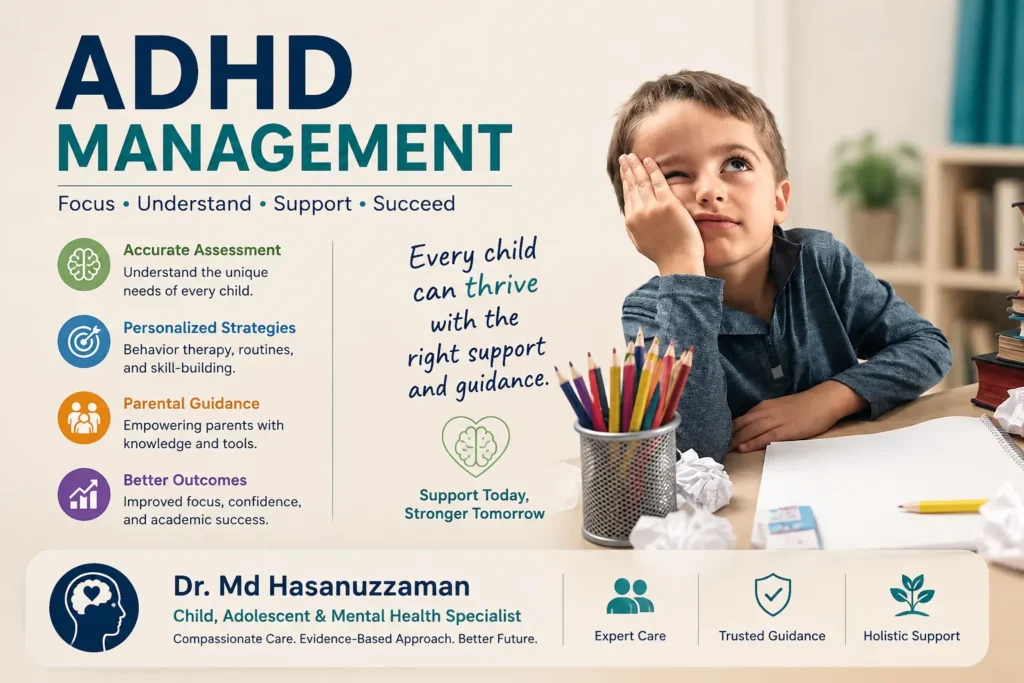
ADHD, or attention-deficit/hyperactivity disorder, is a neurodevelopmental condition that affects attention, activity level, impulse control, emotional regulation, learning, and daily functioning. It is not simply “bad behavior” or “lack of discipline”; proper diagnosis requires a step-by-step assessment because sleep disorders, anxiety, depression, learning difficulties, trauma, and other conditions can look similar to ADHD. (CDC)
ADHD management is most effective when it is individualized. Evidence-based care may include parent training, behavior therapy, classroom support, environmental modification, medication when appropriate, sleep and nutrition guidance, and ongoing monitoring. For children under 6 years, parent training in behavior management is recommended before medication; for children 6 years and older, treatment commonly includes medication and behavior therapy together, with school support included in the care plan. (CDC)
From a homeopathic clinical perspective, ADHD is not treated only as a label. A trained homeopathic physician studies the whole child or adult: temperament, sleep, appetite, fears, sensitivities, triggers, family history, learning style, emotional expression, physical complaints, nutrition, and environmental stressors. This article explains that approach responsibly, while clearly acknowledging that current scientific evidence does not support homeopathy as a proven standalone treatment for ADHD. (Cochrane)
Quick Answer
ADHD management should be holistic, structured, and individualized. It usually includes behavioral strategies, parent training, school support, sleep correction, routine building, nutrition, emotional support, and medical assessment; medication may be helpful or necessary for some children, adolescents, and adults when symptoms cause significant impairment. (CDC)
Homeopathic support for ADHD focuses on the complete person rather than only hyperactivity, impulsivity, or poor focus. It may be used as individualized supportive care under a qualified practitioner, but it should not replace evidence-based ADHD assessment, behavioral intervention, educational support, or prescribed medication when clinically indicated. Cochrane’s review found little evidence for homeopathy as an effective treatment for ADHD, so claims must remain cautious and honest. (Cochrane)
Key Facts Summary
| Key Point | Patient-Friendly Explanation |
|---|---|
| ADHD is neurodevelopmental | It affects attention, impulse control, activity level, planning, and emotional regulation. |
| Diagnosis needs assessment | There is no single test for ADHD; other causes such as sleep problems, anxiety, depression, and learning difficulties must be considered. (CDC) |
| Young children need behavior-first care | For children under 6, parent training in behavior management is recommended before medication. (CDC) |
| School support matters | Classroom interventions, IEPs, and 504 plans may help children function better in school. (CDC) |
| Diet is supportive, not a cure | NICE recommends balanced diet, good nutrition, and regular exercise, but does not advise fatty acid supplements as ADHD treatment. (NICE) |
| Homeopathy is individualized | It considers the person’s total physical, mental, emotional, developmental, and family pattern. |
| Evidence is limited | Cochrane found little evidence for homeopathy’s efficacy in ADHD. (Cochrane) |
| Safety is essential | Homeopathy should not delay diagnosis, school support, behavioral care, or medical treatment when needed. |
Table of Contents
- What Is ADHD?
- ADHD Symptoms: Inattention, Hyperactivity, and Impulsivity
- What Causes ADHD?
- How ADHD Is Diagnosed
- ADHD Management: The Evidence-Based Foundation
- The Holistic Homeopathic Perspective
- Individualized Homeopathic Case-Taking for ADHD
- ADHD in Children: Parent and Family Support
- ADHD in School: Classroom and Learning Support
- ADHD in Adolescents and Adults
- Nutrition, Sleep, Exercise, and Screen-Time Guidance
- Practical Tips for Daily ADHD Management
- Common Mistakes to Avoid
- Prevention and Early Support
- When to Seek Urgent or Specialist Help
- Frequently Asked Questions
- Key Takeaways
- Conclusion
- References & Suggested Links
- Internal Linking Suggestions
- Recommended Schema
- Medical Disclaimer
- Strong Call-to-Action
- About the Doctor
What Is ADHD?
ADHD is a neurodevelopmental condition that affects how the brain manages attention, self-control, activity, planning, and emotional regulation. It begins in childhood, but symptoms may continue into adolescence and adulthood. ADHD is diagnosed when symptoms are persistent, impairing, and present in more than one setting, such as home and school. (AAP Publications)
ADHD does not mean a child is lazy, careless, disobedient, or poorly raised. Many children with ADHD are intelligent, creative, emotionally sensitive, energetic, and capable, but they struggle with executive functions: starting tasks, sustaining attention, controlling impulses, organizing work, waiting turns, and regulating emotions.
A helpful way to understand ADHD is this: the child may know what to do, but may not consistently be able to do it at the right time, in the right order, with the right level of self-control. This is why punishment alone rarely solves ADHD-related problems. The child needs structure, coaching, environmental support, emotional understanding, and individualized treatment.
ADHD Symptoms: Inattention, Hyperactivity, and Impulsivity
ADHD symptoms usually fall into three main groups: inattention, hyperactivity, and impulsivity. Some people mainly struggle with focus, some mainly with hyperactivity and impulsive actions, and many have a combined pattern. Diagnosis requires more than a checklist; symptoms must create real difficulty in daily functioning. (AAP Publications)
Inattention Symptoms
Inattention means difficulty sustaining focus, organizing tasks, remembering instructions, and completing work. A child may appear forgetful, distracted, careless, or slow, even when they are trying.
Common signs include:
| Inattention Pattern | What Parents May Notice |
|---|---|
| Poor sustained attention | Starts homework but quickly loses focus |
| Forgetfulness | Loses books, pencils, water bottle, assignments |
| Disorganization | Messy bag, incomplete classwork, poor time sense |
| Avoids effortful tasks | Refuses long reading, writing, or multi-step work |
| Seems not to listen | Appears absent-minded even during direct instruction |
| Careless mistakes | Knows the answer but misses details |
| Poor follow-through | Begins chores but does not finish |
Hyperactivity Symptoms
Hyperactivity means excessive movement, restlessness, or difficulty staying still when expected. In young children this may look like running, climbing, fidgeting, or constant movement; in adolescents and adults it may become inner restlessness.
Common signs include:
| Hyperactivity Pattern | What It May Look Like |
|---|---|
| Fidgeting | Tapping, moving legs, playing with objects |
| Leaving seat | Gets up repeatedly during class or meals |
| Excessive talking | Talks nonstop or interrupts conversations |
| Restlessness | Cannot relax even when tired |
| Difficulty quiet play | Struggles with calm activities |
Impulsivity Symptoms
Impulsivity means acting before thinking. This can affect safety, friendships, learning, emotional control, and family life.
Common signs include:
| Impulsivity Pattern | Daily Example |
|---|---|
| Interrupting | Answers before the question is complete |
| Difficulty waiting | Cannot wait in line or take turns |
| Emotional outburst | Anger, crying, or frustration comes suddenly |
| Risky actions | Runs into the road, climbs dangerously, grabs things |
| Social problems | Says hurtful words without thinking |
What Causes ADHD?
ADHD has no single cause. Research supports a complex interaction of genetics, brain development, environment, sleep, family stress, learning demands, and coexisting conditions. It is not caused by poor parenting, although parenting strategies can strongly influence how well a child functions day to day.
A medical assessment should consider contributing or aggravating factors such as:
| Contributing Factor | Why It Matters |
|---|---|
| Family history | ADHD often runs in families |
| Sleep problems | Poor sleep can mimic or worsen ADHD symptoms |
| Learning difficulties | Reading, writing, or math problems can create avoidance and frustration |
| Anxiety or depression | Emotional distress may reduce attention |
| Trauma or chronic stress | Can cause hypervigilance and impulsive behavior |
| Screen overuse | May worsen sleep, attention habits, and emotional regulation |
| Nutrition gaps | Irregular meals or poor diet may affect energy and mood |
| Parenting stress | Inconsistent routines can worsen behavior cycles |
From a homeopathic perspective, these factors are part of the patient’s total context. The physician does not ask only, “Does this child have ADHD?” The deeper clinical question is, “What is this child’s individual pattern, what maintains the difficulty, and what support does this family need?”
How ADHD Is Diagnosed
ADHD diagnosis requires a careful process, not one blood test, brain scan, or quick observation. CDC explains that there is no single test for ADHD, and similar symptoms can occur with sleep disorders, anxiety, depression, and learning disabilities. (CDC)
The American Academy of Pediatrics recommends evaluation for children and adolescents aged 4 to the 18th birthday when they present with academic or behavioral problems and symptoms of inattention, hyperactivity, or impulsivity. Diagnosis should confirm DSM-5 criteria, document impairment in more than one major setting, gather information from parents and teachers, and rule out alternative causes. (AAP Publications)
What a Good ADHD Assessment Includes
| Assessment Area | What Should Be Reviewed |
|---|---|
| Parent history | Pregnancy, birth, development, behavior, sleep, appetite, emotions |
| Teacher report | Classroom attention, peer behavior, learning, task completion |
| Rating scales | Standardized ADHD symptom and impairment scales |
| Developmental history | Speech, motor skills, learning, social milestones |
| Medical history | Seizures, thyroid issues, hearing, vision, sleep, medications |
| Mental health review | Anxiety, depression, trauma, oppositional behavior |
| Learning evaluation | Reading, writing, math, memory, processing speed |
| Family and environment | Routine, stress, screen use, parenting patterns |
A proper diagnosis protects the child from both under-treatment and mislabeling. A restless child may have ADHD, but may also be sleep-deprived, anxious, overstimulated, bullied, struggling with dyslexia, or living in a chaotic routine. This is why individualized assessment is essential.
ADHD Management: The Evidence-Based Foundation
ADHD management works best when it combines family education, behavioral strategies, school support, lifestyle correction, and medical treatment when needed. There is no one-size-fits-all plan. The goal is not to “change the child’s personality,” but to reduce impairment, improve safety, strengthen learning, and support emotional development.
CDC summarizes age-based recommendations: for children under 6, parent training in behavior management is recommended before medication; for children 6 and older, medication and behavior therapy are commonly recommended together, including parent training, classroom behavioral interventions, peer-focused interventions, and organizational skills training. (CDC)
Evidence-Based Management Options
| Management Area | Purpose |
|---|---|
| Parent training | Helps parents use structure, praise, consequences, and routines effectively |
| Behavior therapy | Builds practical skills for behavior change |
| Classroom support | Reduces learning barriers and improves task completion |
| Organizational skills training | Helps with planning, homework, materials, and time management |
| Medication | May reduce core ADHD symptoms when clinically appropriate |
| Sleep and routine | Reduces aggravating factors |
| Nutrition and exercise | Supports brain health, mood, and energy regulation |
| Counseling or CBT | Useful for adolescents/adults with emotional or executive function difficulties |
Medication should be individualized and monitored by trained professionals. NICE states that ADHD medication should be initiated only by healthcare professionals with training and expertise in diagnosing and managing ADHD. (NICE)
The Holistic Homeopathic Perspective
The homeopathic perspective views ADHD management through the whole person: mind, emotions, body, family, environment, development, sleep, appetite, fears, sensitivities, and behavior patterns. It does not responsibly claim that one remedy “cures ADHD.” Instead, it studies the individual expression of ADHD-like difficulties and aims to support the patient’s overall balance.
NCCIH explains that homeopathy is based on principles such as “like cures like” and minimum dose, and that treatments are individualized; however, NCCIH also notes that there is little evidence supporting homeopathy as effective for any specific health condition. (NCCIH)
For ADHD specifically, Cochrane reviewed trials of homeopathy and concluded that there was little evidence for efficacy in ADHD. (Cochrane) Therefore, the safest and most ethical position is:
Homeopathy may be considered as individualized supportive care, but it should not replace proper ADHD diagnosis, parent training, behavioral intervention, school support, or medication when clinically indicated.
What Homeopathic Physicians Look For
A homeopathic physician may explore:
| Homeopathic Case Area | Clinical Relevance |
|---|---|
| Temperament | Sensitive, restless, defiant, anxious, fearful, impulsive, withdrawn |
| Triggers | Noise, criticism, sugar, lack of sleep, screen time, school pressure |
| Sleep | Delayed sleep, nightmares, restless sleep, waking unrefreshed |
| Appetite | Cravings, aversions, irregular eating, digestive complaints |
| Emotional pattern | Anger, shame, rejection sensitivity, clinginess, low confidence |
| Physical generals | Sweating, heat/cold sensitivity, allergies, eczema, headaches |
| Development | Speech delay, motor delay, learning style, social development |
| Family history | ADHD, anxiety, allergies, migraine, thyroid disease, mood disorders |
| Modalities | Better or worse from movement, pressure, routine, open air, company |
This whole-person assessment matches Dr. Md. Hasanuzzaman’s clinical interests in pediatrics, child development, behavioral disorders, mental health, nutrition, lifestyle medicine, allergy, asthma, eczema, and digestive disorders.
Individualized Homeopathic Case-Taking for ADHD
Homeopathic case-taking for ADHD is detailed because the “same diagnosis” may look very different in different children. One child may be impulsive, loud, fearless, and destructive; another may be dreamy, slow, forgetful, anxious, and easily overwhelmed. The homeopathic prescription, if used, is based on the total pattern—not the ADHD label alone.
Areas Explored in a Child ADHD Case
| Case-Taking Question | Why It Matters |
|---|---|
| When did symptoms begin? | Early childhood, after stress, after school pressure, after illness |
| Where are symptoms worst? | Home, school, public places, homework time |
| What improves the child? | Movement, routine, praise, quiet room, one-to-one attention |
| What worsens the child? | Hunger, fatigue, noise, criticism, screen time, transitions |
| How does anger appear? | Sudden shouting, hitting, crying, withdrawal, guilt after anger |
| How is sleep? | Late sleep, nightmares, grinding teeth, restless legs |
| What are food patterns? | Cravings, picky eating, irregular meals, digestive symptoms |
| What are physical tendencies? | Allergies, eczema, asthma, recurrent infections, headaches |
| What is the child’s strength? | Creativity, memory, humor, leadership, empathy, curiosity |
The Importance of Individuality
In classical homeopathic philosophy, the practitioner seeks the individualizing features. For ADHD, these may include emotional sensitivity, fear patterns, sleep features, reaction to correction, sensory sensitivities, digestive tendencies, or the way the child behaves when overstimulated.
This is why responsible homeopathic care should avoid fixed formulas such as “one remedy for hyperactivity” or “one remedy for concentration.” Such simplified prescribing does not reflect the individualized philosophy of homeopathy and may delay more useful support.
Evidence Honesty in Homeopathic ADHD Care
Families deserve honesty. Some parents report improvement with individualized homeopathic care, especially when consultations also improve routine, sleep, diet, parenting consistency, and emotional understanding. However, clinical experience is not the same as proof of disease-specific effectiveness. Cochrane found little evidence supporting homeopathy for ADHD, and FDA notes that homeopathic products have not been reviewed for safety and effectiveness in the same way as approved medicines. (Cochrane)
ADHD in Children: Parent and Family Support
Parents are central to ADHD management because the child needs repeated, predictable, calm guidance. ADHD behavior often worsens when adults respond with shouting, long lectures, inconsistent punishment, or unrealistic expectations. Parent training helps families replace emotional reaction with structured response.
CDC notes that parent training in behavior management gives parents skills and strategies to help their child and is recommended first for young children with ADHD. (CDC)
Practical Parent Strategies
| Strategy | How to Apply It |
|---|---|
| Give one instruction at a time | “Put your book in the bag,” then wait |
| Use visual routines | Morning chart, homework chart, bedtime chart |
| Praise specific behavior | “You sat for 10 minutes and finished two lines” |
| Use immediate consequences | Small, predictable, non-harsh consequences |
| Break tasks | 20-minute homework becomes 5-minute steps |
| Prepare transitions | “In 5 minutes we will stop playing and start dinner” |
| Reduce shouting | Calm repetition works better than emotional escalation |
| Protect sleep | ADHD symptoms often worsen with poor sleep |
Parents should also notice strengths. Children with ADHD often hear more correction than appreciation. Daily positive feedback is not “spoiling”; it builds emotional safety and cooperation.
ADHD in School: Classroom and Learning Support
School support is often necessary because ADHD symptoms usually become more visible when a child must sit still, listen, copy, organize materials, wait turns, and complete written work. A child may understand lessons but fail to submit work due to executive function difficulty.
CDC explains that school treatment plans may include an Individualized Education Program, which provides individualized special education services, or a Section 504 Plan, which provides services and changes to the learning environment. (CDC)
Helpful Classroom Adjustments
| School Challenge | Possible Support |
|---|---|
| Distractibility | Seat near teacher, away from door/window |
| Incomplete work | Break assignments into smaller parts |
| Forgetting homework | Use planner, parent-teacher communication notebook |
| Impulsivity | Clear classroom rules and immediate feedback |
| Restlessness | Movement breaks, classroom jobs |
| Test problems | Extra time, quiet testing area |
| Poor organization | Color-coded folders, checklist before leaving school |
| Emotional outbursts | Calm-down plan, predictable response |
A homeopathic physician should encourage school collaboration, not isolate treatment inside the clinic. ADHD management works best when parents, teachers, physicians, and the child work together.
ADHD in Adolescents and Adults
ADHD can continue into adolescence and adulthood, although symptoms may change. Hyperactivity may become internal restlessness, while problems with procrastination, time management, emotional regulation, forgetfulness, and impulsive decisions may become more prominent.
NICE includes ADHD diagnosis and management across children, young people, and adults, and recommends medication for adults when ADHD symptoms still cause significant impairment after environmental modifications have been implemented and reviewed. (NICE)
Adult ADHD May Look Like
| Area | Common Difficulty |
|---|---|
| Work | Missed deadlines, disorganization, unfinished tasks |
| Study | Procrastination, poor planning, exam stress |
| Relationships | Interrupting, emotional reactivity, forgetfulness |
| Money | Impulsive spending, unpaid bills |
| Sleep | Delayed bedtime, racing thoughts |
| Self-esteem | Feeling lazy, guilty, or “not good enough” |
Homeopathic assessment in adults explores not only focus, but also anxiety, sleep, digestion, headaches, hormonal factors, work stress, trauma history, substance use, relationship strain, and lifestyle rhythm. Adults may also benefit from coaching, CBT, medication review, exercise, structured planning systems, and environmental modifications.
Nutrition, Sleep, Exercise, and Screen-Time Guidance
Lifestyle does not “cure” ADHD, but it can significantly affect symptom intensity, emotional regulation, sleep, appetite, and learning readiness. NICE recommends stressing the value of balanced diet, good nutrition, and regular exercise for children, young people, and adults with ADHD. (NICE)
Nutrition Guidance
A balanced diet supports stable energy, growth, mood, and concentration. NICE advises against using artificial color and additive elimination as a general ADHD treatment and does not advise fatty acid supplementation for treating ADHD in children and young people. If parents notice a clear link between certain foods or drinks and behavior, NICE recommends a diary and dietitian referral if the diary supports the relationship. (NICE)
Helpful nutrition habits include:
| Goal | Practical Advice |
|---|---|
| Stable energy | Regular meals, especially breakfast |
| Protein support | Egg, fish, chicken, lentils, beans, yogurt |
| Micronutrient support | Fruits, vegetables, nuts, seeds, whole grains |
| Reduce irritability | Avoid long gaps without food |
| Monitor triggers | Keep a food-behavior diary only if a pattern is suspected |
| Safe supplementation | Test and supplement only when clinically indicated |
Sleep Guidance
Sleep problems can worsen attention, impulse control, mood, and behavior. Since sleep disorders can mimic ADHD symptoms, sleep history should be part of assessment. (CDC)
Helpful sleep practices include:
- Fixed wake-up and bedtime.
- No screens 60 minutes before sleep.
- Light dinner, not too late.
- Calm bedtime routine.
- Morning sunlight exposure.
- Check snoring, mouth breathing, restless legs, nightmares, or sleep apnea symptoms.
Exercise and Movement
Movement is not a luxury for children with ADHD; it is part of regulation. WHO states that any amount of physical activity is better than none, all physical activity counts, and sedentary time should be limited across age groups. (World Health Organization)
Good options include:
- Running
- Cycling
- Swimming
- Martial arts
- Football or cricket
- Dance
- Skipping
- Outdoor play
- Structured movement breaks during study
Practical Tips for Daily ADHD Management
ADHD improves with structure, repetition, and compassionate consistency. The best strategies are simple enough to repeat daily.
Home Routine Tips
| Problem | Practical Solution |
|---|---|
| Morning chaos | Use a visual checklist: brush, dress, breakfast, bag |
| Homework battles | Use timer-based short sessions |
| Forgetfulness | Keep school items in one fixed place |
| Emotional outburst | Use a calm-down corner, not shame |
| Screen conflict | Set screen rules before giving device |
| Poor listening | Give eye-level, short instructions |
| Messy room | Clean by category: books first, clothes second |
| Bedtime delay | Same 30-minute routine every night |
Study Tips
- Use 10–15 minute focus blocks.
- Keep the table clear.
- Use written instructions.
- Start with the easiest task.
- Give short movement breaks.
- Praise effort, not only marks.
- Use a visible timer.
- Review school diary daily.
Emotional Regulation Tips
Children with ADHD often feel ashamed after being corrected repeatedly. Emotional support should include:
- Naming feelings: “You are frustrated.”
- Teaching pause skills: breathe, count, drink water.
- Avoiding labels: do not call the child lazy, naughty, or useless.
- Repairing after conflict: “We were both upset. Let’s try again.”
- Building confidence through small success.
Common Mistakes to Avoid
ADHD management becomes harder when families rely only on punishment, ignore sleep, delay assessment, or expect the child to “just try harder.” ADHD needs skill-building, not blame.
Mistake 1: Thinking ADHD Is Only Bad Behavior
ADHD affects executive function. Discipline matters, but punishment alone does not teach planning, impulse control, or emotional regulation.
Mistake 2: Delaying Professional Assessment
Because many conditions can mimic ADHD, a proper evaluation is important. CDC notes that diagnosis has several steps and there is no single test. (CDC)
Mistake 3: Using Homeopathy as a Replacement for All Care
Homeopathy should not replace diagnosis, school support, parent training, behavior therapy, or medication when clinically required. Evidence for homeopathy in ADHD remains limited. (Cochrane)
Mistake 4: Ignoring the School
ADHD is often most impairing in school. Classroom support, teacher communication, and academic accommodations can be essential. (CDC)
Mistake 5: Overusing Supplements Without Assessment
Supplements should not be used as a substitute for diagnosis or balanced diet. NICE does not recommend dietary fatty acid supplementation as ADHD treatment in children and young people. (NICE)
Prevention and Early Support
ADHD itself cannot always be prevented, but impairment can often be reduced through early recognition, structured parenting, sleep correction, school support, and emotional care. Early support may protect self-esteem, learning confidence, family relationships, and social development.
Prevention-focused support includes:
| Area | What Helps |
|---|---|
| Early recognition | Notice persistent impairment, not occasional restlessness |
| Parent education | Learn ADHD-friendly discipline |
| Sleep protection | Treat sleep problems early |
| Nutrition | Maintain regular meals and balanced diet |
| Movement | Daily outdoor play and physical activity |
| Screen boundaries | Avoid unlimited, unstructured screen use |
| School communication | Share strategies with teachers |
| Emotional support | Reduce shame and build confidence |
In homeopathic practice, prevention also means identifying constitutional vulnerabilities: oversensitivity, recurrent physical illness, anxiety, poor sleep, digestive weakness, allergy tendency, or stress reactivity. These observations help build a broader care plan.
When to Seek Urgent or Specialist Help
ADHD symptoms need specialist attention when they cause significant impairment, safety risks, severe emotional distress, school failure, aggression, self-harm thoughts, substance use, or major family disruption. ADHD may coexist with anxiety, depression, autism spectrum disorder, learning disorders, tic disorders, sleep disorders, and oppositional behavior.
Seek professional help if:
- The child is unsafe due to impulsivity.
- School performance is seriously affected.
- There are frequent aggressive outbursts.
- The child talks about self-harm or hopelessness.
- There is severe anxiety, depression, or trauma history.
- Sleep is very poor or snoring is significant.
- Parents feel exhausted and unable to cope.
- Symptoms continue despite routine and behavior support.
- Medication side effects occur.
- Diagnosis is uncertain.
A qualified physician should coordinate care and refer to pediatric, psychiatric, psychological, educational, or developmental specialists when needed.
Frequently Asked Questions
1. What is ADHD?
ADHD is a neurodevelopmental condition that affects attention, impulse control, activity level, organization, and emotional regulation. It can affect school, work, relationships, and daily routines.
2. Is ADHD caused by bad parenting?
No. ADHD is not caused by bad parenting. However, parenting strategies can strongly affect how well a child manages ADHD symptoms day to day.
3. How is ADHD diagnosed?
ADHD is diagnosed through a multi-step assessment, not a single test. Information is usually collected from parents, teachers, rating scales, medical history, developmental history, and functional impairment across settings. (AAP Publications)
4. Can ADHD be managed without medication?
Some children, especially younger children, may improve with parent training, behavior therapy, routines, school support, and lifestyle changes. Others need medication as part of care when symptoms cause significant impairment. (CDC)
5. What is the role of homeopathy in ADHD?
Homeopathy may be used as individualized supportive care, focusing on the whole person’s physical, emotional, developmental, and behavioral pattern. It should not replace evidence-based diagnosis, behavior therapy, school support, or medication when needed.
6. Is there scientific proof that homeopathy cures ADHD?
No strong scientific proof shows that homeopathy cures ADHD. Cochrane found little evidence for homeopathy’s efficacy in ADHD, so claims should remain cautious. (Cochrane)
7. What is the best homeopathic medicine for ADHD?
There is no single best homeopathic medicine for ADHD. Classical homeopathy selects remedies according to the individual symptom pattern, temperament, sleep, appetite, fears, triggers, and general constitution.
8. Can diet improve ADHD?
Balanced diet, regular meals, and good nutrition can support overall functioning. NICE recommends balanced diet and regular exercise but does not recommend fatty acid supplements as ADHD treatment for children and young people. (NICE)
9. Should sugar or food color be removed?
Not for every child automatically. If parents notice a clear food-behavior link, they can keep a diary and seek dietitian guidance if the pattern is consistent. NICE does not recommend artificial color and additive elimination as a general ADHD treatment. (NICE)
10. Does screen time worsen ADHD?
Unstructured excessive screen time may worsen sleep, routines, emotional regulation, and attention habits in many children. A structured screen plan, outdoor play, and a fixed bedtime routine are often helpful.
11. How can parents help a child with ADHD study?
Use short study blocks, visual checklists, a clean desk, movement breaks, a timer, simple instructions, and frequent encouragement. Focus on consistency rather than long lectures.
12. Can ADHD continue into adulthood?
Yes. ADHD may continue into adolescence and adulthood. Adults may struggle more with planning, procrastination, time management, emotional regulation, forgetfulness, and work organization.
13. When should ADHD medication be considered?
Medication may be considered when ADHD symptoms cause significant impairment and should be prescribed and monitored by trained professionals. NICE states ADHD medication should be initiated by healthcare professionals with expertise in ADHD diagnosis and management. (NICE)
14. Can school accommodations help ADHD?
Yes. Classroom supports, behavior plans, IEPs, and 504 plans can reduce learning barriers and improve functioning. (CDC)
15. When should parents seek urgent help?
Seek urgent help if the child has self-harm thoughts, severe aggression, unsafe impulsivity, severe depression, substance use, major sleep disturbance, or serious decline in school or family functioning.
16. What is Homeo Care?
Homeo Care is a patient-centered homeopathic consultation center led by Dr. Md. Hasanuzzaman, a Homeopathic Physician, Clinical Nutritionist, and Medical Educator with more than 14 years of clinical experience. The clinic focuses on individualized homeopathic care, nutritional guidance, lifestyle advice, and long-term health support.
17. Who is Dr. Md. Hasanuzzaman?
Dr. Md. Hasanuzzaman is a Homeopathic Physician, Clinical Nutritionist, and Medical Educator. He serves as a Lecturer in the Department of Physiology at Noagaon Homeopathic Medical College and Hospital and is the Founder Director of the Homeopathic Research and Development Foundation (HRDF).
18. What types of health concerns are treated at Homeo Care?
Homeo Care provides consultation for a wide range of health concerns, including women’s health, infertility support, child health, ADHD and behavioral concerns, mental health, allergy, asthma, eczema, digestive problems, pain management, lifestyle-related conditions, and general chronic health issues.
19. How does homeopathic treatment work at Homeo Care?
Homeopathic care at Homeo Care is individualized. Instead of focusing only on the disease name, the doctor evaluates the patient’s physical symptoms, emotional state, lifestyle, food habits, sleep, medical history, family history, and overall constitution before selecting a treatment plan.
20. Is homeopathic treatment the same for every patient?
No. In classical homeopathy, treatment is selected according to the individual patient. Two people with the same disease may receive different homeopathic medicines depending on their symptoms, constitution, triggers, and overall health pattern.
21. Is online consultation available?
Yes. Online consultation is available for patients who are unable to visit the chamber in person. Online appointments should be scheduled in advance.
22. Where is the Jessore chamber located?
Homeo Care – Jessore is located at:
822/A East Barandipara,
Bottola More, Jashore
Visiting hours:
Monday, Tuesday, Thursday & Friday
10:00 AM – 7:00 PM
Appointment:
+8801717250951
23. Where is the Dhaka chamber located?
Homeo Care – Dhaka is located at:
42/4 Hatkhola Road,
Tikatuli, Motijheel, Dhaka-1203
Lift-4, Janata Bank Building
Beside Rajdhani Market
Visiting hours:
Saturday, Sunday & Wednesday
1:00 PM – 8:00 PM
Appointment:
+8801752308302
24. Do I need an appointment before visiting Homeo Care?
Yes. It is recommended to book an appointment before visiting so that the consultation time can be properly managed.
25. What should I bring for my first consultation?
Please bring your previous prescriptions, investigation reports, diagnosis papers, current medicine list, and any relevant medical records. For children, parents should also share details about birth history, growth, behavior, sleep, appetite, school performance, and previous illnesses.
26. How long does the first consultation take?
The first consultation may take longer than a regular follow-up because detailed case-taking is needed. The doctor may ask about physical symptoms, mental and emotional health, lifestyle, food habits, sleep, medical history, and family background.
27. Does Homeo Care provide nutrition and lifestyle guidance?
Yes. Since Dr. Md. Hasanuzzaman is also a Clinical Nutritionist, consultation may include food habits, nutritional support, sleep, exercise, stress management, and lifestyle guidance where relevant.
28. Can I consult for chronic diseases?
Yes. Homeo Care provides individualized consultation for many chronic health concerns. Chronic cases require detailed history, previous reports, long-term symptom analysis, and regular follow-up.
29. How can I book an appointment?
You can book an appointment by calling the chamber numbers:
Jessore Chamber: +8801717250951
Dhaka Chamber: +8801752308302
Online consultation is also available by prior appointment.
Key Takeaways
ADHD is a real neurodevelopmental condition, not laziness or poor discipline. Diagnosis requires careful assessment because sleep disorders, anxiety, depression, learning difficulties, and other problems can mimic ADHD. (CDC)
The strongest ADHD management plans are individualized. Parent training, behavior therapy, school support, lifestyle correction, and medical treatment when needed can work together. (CDC)
Homeopathic support should be presented responsibly. It may help families through individualized, whole-person assessment and supportive care, but current evidence does not prove homeopathy as a standalone ADHD treatment. (Cochrane)
Conclusion
ADHD management should be compassionate, structured, evidence-informed, and deeply individualized. A child with ADHD does not need blame; the child needs understanding, routine, skill-building, family support, school cooperation, and appropriate medical guidance.
The homeopathic clinical perspective adds value by looking at the whole person: temperament, sleep, appetite, fears, sensitivities, emotional expression, physical tendencies, family environment, and developmental history. However, responsible homeopathic care must remain honest about the limits of evidence and should never delay diagnosis, behavioral care, educational support, or medication when needed.
For families, the most practical path is integrated care: medical assessment for safety, parent training for daily structure, school support for learning, lifestyle correction for regulation, and individualized homeopathic consultation where appropriate.
About the Author
Dr. Md. Hasanuzzaman
Homeopathic Physician | Clinical Nutritionist | Medical Educator
Dr. Md. Hasanuzzaman is a Homeopathic Physician and Clinical Nutritionist with more than 14 years of clinical experience in individualized patient care. His professional work focuses on understanding the whole person—not merely the disease—by integrating classical homeopathic principles with careful clinical assessment, nutritional evaluation, lifestyle guidance, and long-term health management.
He serves as a Lecturer in the Department of Physiology at Noagaon Homeopathic Medical College and Hospital and is the Founder Director of the Homeopathic Research and Development Foundation (HRDF). His major clinical interests include infertility, women’s health, child development, behavioral disorders, mental health, pain management, allergy, digestive disorders, and lifestyle-related chronic conditions.
The educational content published on drbarirobel.com/ is intended to provide reliable, evidence-informed health information while supporting informed discussions between patients and qualified healthcare professionals.
Book a Consultation
If you would like a personalized assessment or want to discuss your health concerns in detail, appointments are available at both Jessore and Dhaka chambers. Online consultation is also available where appropriate.
📍 Jashore Chamber
822/A East Barandipara,
Bottola More, Jashore
Visiting Hours
Monday, Tuesday, Thursday & Friday
10:00 AM – 7:00 PM
Appointment
+8801717250951
📍 Dhaka Chamber
42/4 Hatkhola Road
Tikatuli, Motijheel, Dhaka-1203
Lift-4, Janata Bank Building
Beside Rajdhani Market
Visiting Hours
Saturday, Sunday & Wednesday
1:00 PM – 8:00 PM
Appointment
+8801752308302
Online Consultation
For patients who are unable to visit the chamber in person, online consultation services are also available by prior appointment.
Medical Disclaimer
This article is intended for educational purposes only and should not be considered a substitute for professional medical advice, diagnosis, or treatment. Healthcare decisions should always be based on an individualized clinical assessment by a qualified healthcare professional. If you have severe, persistent, or emergency symptoms, seek appropriate medical care without delay.