Dr. Md. Hasanuzzaman: Clinical Philosophy, Medical Education and Research Vision
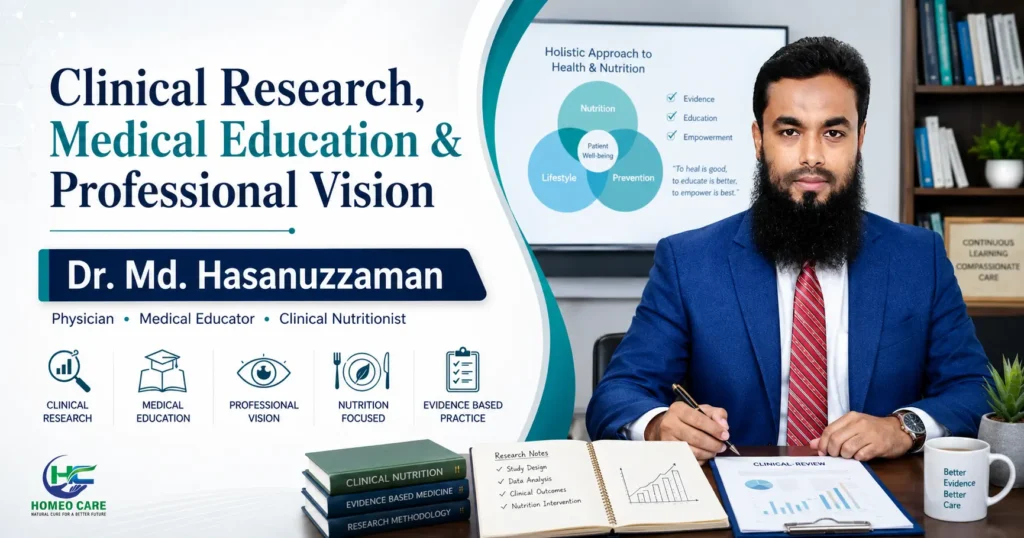
Dr. Md. Hasanuzzaman is a homeopathic physician, clinical nutritionist and medical educator. His professional work combines patient-centred consultation, clinical documentation, nutrition awareness and health education.
His qualifications include DHMS (Dhaka), BHMS (DU Apprentice), PG Hom. (London), MPH in Nutrition from IU and MA from National University. He is registered under Registration No. H-22527.
Dr. Md. Hasanuzzaman believes that clinical experience becomes more useful when it is documented carefully. Therefore, his professional approach gives importance to accurate records, planned follow-up and responsible communication.
He also recognises the limits of clinical observation. An individual patient experience may offer an educational lesson. However, it cannot prove that the same treatment will work for everyone.
A Patient-Centred Clinical Philosophy
Dr. Md. Hasanuzzaman’s clinical philosophy begins with careful listening.
During a consultation, he considers the patient’s main complaint and medical history. He may also review current medicines, previous treatment, investigation reports, nutrition, sleep and daily functioning.
However, he does not consider every detail equally important. Information should be relevant to the patient’s health and clinical care.
His professional approach focuses on:
- respect for every patient;
- careful history-taking;
- clear clinical records;
- honest communication;
- recognition of clinical limitations;
- planned follow-up;
- appropriate referral;
- continuous professional learning.
Dr. Md. Hasanuzzaman does not believe that a healthcare professional must have an immediate answer to every question. In some situations, further investigation or referral may be necessary.
Therefore, acknowledging uncertainty is an important part of responsible clinical care.
From Experience to Professional Knowledge
A physician may gain valuable experience over many years. However, experience alone does not automatically become reliable knowledge.
Clinical information becomes more useful when it is organised and reviewed. For example, the clinician should know what the patient reported, what was observed and what changed during follow-up.
Dr. Md. Hasanuzzaman’s research-oriented approach includes:
- recording clinical histories;
- reviewing current medicines;
- examining available reports;
- identifying warning signs;
- planning follow-up;
- documenting improvement or deterioration;
- considering alternative explanations;
- reviewing incomplete outcomes.
This process supports reflection and professional learning.
It also helps prevent an important problem: assuming that every improvement happened because of one treatment.
A patient’s condition may change for many reasons. These may include natural recovery, lifestyle changes, concurrent treatment or changes in stress and sleep.
Therefore, clinical outcomes should be interpreted with care.
Why Clinical Documentation Matters
Clinical documentation is a major area of Dr. Md. Hasanuzzaman’s professional interest.
A clear clinical record supports continuity of care. It also helps the physician review previous decisions.
Without proper documentation, important information may be forgotten. As a result, follow-up may become less accurate.
A structured clinical record may include the following areas.
Presenting Health Concerns
The record should describe the patient’s main complaints.
It may include:
- when the symptoms started;
- how long they have continued;
- their severity and frequency;
- factors that make them better or worse;
- associated symptoms;
- effects on daily life.
This information creates a clearer starting point for future review.
Medical and Treatment History
Relevant medical history should also be recorded.
This may include:
- previous diagnoses;
- hospital admission;
- surgical history;
- allergies;
- current prescription medicines;
- supplements;
- previous treatment;
- laboratory reports;
- imaging reports.
This information is important because many patients receive care from more than one healthcare professional.
Lifestyle and Nutrition
Dr. Md. Hasanuzzaman also has training in nutrition. Therefore, he may review dietary habits when they are relevant.
He may consider:
- appetite;
- hydration;
- food habits;
- physical activity;
- sleep;
- stress;
- weight changes.
However, nutrition should not be presented as the only explanation for every condition.
In addition, patients may require medical tests or specialist nutritional support. Referral should be considered when necessary.
Clinical Assessment and Safety
The clinical record may include relevant examination findings and available test results.
It should also identify warning signs.
Examples may include:
- severe or rapidly worsening symptoms;
- breathing difficulty;
- altered consciousness;
- unexplained bleeding;
- neurological symptoms;
- persistent high fever;
- severe dehydration;
- significant unexplained weight loss.
When serious concerns appear, urgent medical assessment may be required.
Management and Follow-Up
The record should clearly state what advice or treatment was provided.
It should also include:
- dosage instructions;
- supportive advice;
- follow-up date;
- safety information;
- referral advice.
During follow-up, the clinician should record both positive and negative changes.
This may include:
- improvement;
- no significant change;
- deterioration;
- new symptoms;
- treatment changes;
- referral;
- loss to follow-up.
Clinical Nutrition and Patient Education
Nutrition is another important part of Dr. Md. Hasanuzzaman’s professional background.
His nutrition-related interests include dietary history, family health education and lifestyle awareness.
He may also discuss balanced eating, hydration and healthy daily habits.
However, dietary advice should be individualised. It should also remain within professional scope.
For example, a patient with a suspected nutritional deficiency may need laboratory testing. Another patient may require support from a dietitian or specialist physician.
Therefore, nutrition education should complement appropriate medical assessment. It should not replace it.
Medical Education as a Professional Responsibility
Dr. Md. Hasanuzzaman considers patient education an important professional responsibility.
Patients can make better decisions when health information is clear and understandable.
For this reason, medical communication should explain:
- why a test may be necessary;
- why follow-up is important;
- which symptoms require urgent care;
- why prescribed medicines should not be stopped suddenly;
- why one patient’s experience cannot apply to everyone;
- when specialist care may be required.
Medical education should reduce confusion. It should not create fear or unrealistic expectations.
Dr. Md. Hasanuzzaman’s educational interests also include medical writing and public-health communication.
His aim is to present health information in a responsible and accessible way.
Responsible Medical Writing
Online health information can reach many people. Therefore, accuracy is essential.
Dr. Md. Hasanuzzaman supports medical content that:
- identifies the author;
- presents qualifications accurately;
- includes publication and review dates;
- avoids guaranteed cure claims;
- explains important limitations;
- uses reliable references;
- recommends medical assessment when needed;
- includes a clear disclaimer.
Health articles should not exist only to target search keywords.
Instead, each article should answer a genuine patient question. It should also help readers make safer decisions.
A Research-Oriented Clinical Mindset
Dr. Md. Hasanuzzaman views research as a process of careful questioning.
A research-oriented physician may ask:
- Is the clinical history complete?
- Has the patient received an appropriate diagnosis?
- What other treatments are being used?
- Has the patient completed follow-up?
- Could another factor explain the outcome?
- Were new or unexpected symptoms documented?
- What information is still missing?
These questions support better clinical reflection.
They also reduce the risk of confirmation bias. Confirmation bias occurs when someone notices only information that supports an existing belief.
For this reason, both favourable and unfavourable outcomes should be documented.
Ethical Use of Clinical Cases
Patient information is collected primarily for clinical care.
Therefore, a routine clinical record should not automatically become a public article or social-media post.
Before publishing a case, several issues should be reviewed:
- informed consent;
- patient privacy;
- risk of identification;
- possible emotional or social harm;
- clinical accuracy;
- alternative explanations;
- limitations of the case.
Removing the patient’s name may not be enough.
A person may still be recognised through age, occupation, location, photographs or a rare condition.
Therefore, careful de-identification is necessary.
Consent for clinical care is also different from consent for publication. Separate permission may be required for photographs, videos, testimonials or public case reports.
Case Reports and Their Limitations
A case report may provide an educational observation.
It may also highlight an unusual event or important referral decision.
However, a case report cannot prove general treatment effectiveness.
It has several limitations. For example:
- there is usually no comparison group;
- the patient may use other treatments;
- natural recovery may occur;
- follow-up may be incomplete;
- outcomes may be subjective.
Therefore, Dr. Md. Hasanuzzaman supports cautious language.
Appropriate statements include:
- “The patient reported improvement.”
- “The case provides an educational observation.”
- “Several factors may have influenced the outcome.”
- “Causation cannot be established.”
- “Further research would be required.”
Statements such as “This case proves the treatment works” should be avoided.
Scientific Transparency
Homeopathy remains a scientifically debated field.
Therefore, patient testimonials or individual cases should not be presented as definitive proof.
Dr. Md. Hasanuzzaman’s professional approach distinguishes between:
- a patient experience;
- a clinical observation;
- a case report;
- a case series;
- an observational study;
- a clinical trial;
- a systematic review.
These forms of information do not provide the same level of evidence.
A stronger medical claim requires stronger research methods.
Therefore, conclusions should always match the quality of the available evidence.
Patient Safety and Referral
Patient safety remains central to Dr. Md. Hasanuzzaman’s professional vision.
Homeopathic consultation should not replace emergency treatment or necessary medical care.
Patients should not delay:
- diagnostic tests;
- hospital treatment;
- surgery;
- vaccination;
- prescribed antimicrobial treatment;
- specialist consultation;
- essential long-term medication.
Patients should also avoid stopping prescribed medicines without consulting the responsible healthcare professional.
Referral may be required when a condition falls outside the clinician’s scope.
In addition, referral decisions should be recorded clearly.
Adverse and Unexpected Events
Responsible clinical documentation should include unexpected and unfavourable outcomes.
These may include:
- new symptoms;
- worsening symptoms;
- suspected adverse reactions;
- possible medicine interactions;
- emergency visits;
- hospital admission;
- treatment discontinuation;
- referral;
- loss to follow-up.
A serious change should not automatically be described as a normal treatment reaction.
Instead, it should receive appropriate clinical assessment.
This approach protects patient safety and supports more honest professional learning.
Clinical Audit and Quality Improvement
Clinical audit can help identify weaknesses in clinical practice.
An audit may review:
- completeness of histories;
- documentation of medicines;
- allergy records;
- investigation reports;
- recognition of red flags;
- referrals;
- follow-up completion;
- consent records;
- privacy procedures.
The purpose of audit is improvement.
It should not be used only to create favourable promotional statistics.
Clinical audit is also different from formal research. Therefore, it should not be described as a research study unless it meets the required standards.
Responsible Use of Artificial Intelligence
Artificial intelligence may assist with writing, translation and information organisation.
However, it requires human supervision.
AI should not invent:
- patient histories;
- diagnoses;
- test results;
- research findings;
- quotations;
- references;
- professional qualifications;
- consent.
The named author or reviewer remains responsible for published information.
Therefore, AI should support professional work. It should not replace clinical judgement or ethical responsibility.
Areas of Professional Interest
Dr. Md. Hasanuzzaman’s professional interests include:
- patient-centred consultation;
- structured case-taking;
- clinical documentation;
- clinical nutrition;
- child and family health education;
- patient communication;
- clinical audit;
- research ethics;
- case-report methodology;
- medical writing;
- digital health communication;
- responsible use of AI;
- interdisciplinary learning.
These interests do not automatically indicate specialist certification.
Any specialist qualification should be stated separately and supported by verifiable credentials.
Professional Role at Homeo Care
Dr. Md. Hasanuzzaman is professionally associated with Homeo Care Bangladesh.
There, he contributes to clinical consultation, patient education and documentation-focused development.
His work supports a clinical environment where:
- patient information is recorded;
- follow-up is encouraged;
- confidentiality is respected;
- warning signs are recognised;
- referrals are made when necessary;
- public communication remains responsible.
Homeo Care’s institutional research and documentation framework is presented separately on the official Homeo Care website.
This separation helps readers understand the difference between the clinic’s institutional policies and Dr. Hasanuzzaman’s personal professional vision.
Future Professional Vision
Dr. Md. Hasanuzzaman’s future professional priorities may include:
- improved clinical-record systems;
- documentation templates;
- regular case discussions;
- clinical audit;
- stronger consent procedures;
- ethical case reporting;
- nutrition education;
- professional seminars;
- educational publications;
- interdisciplinary collaboration.
These priorities represent areas of future development.
Therefore, they should not be presented as completed research programmes unless formal evidence is available.
Professional Collaboration
Dr. Md. Hasanuzzaman welcomes responsible professional and academic communication.
Possible areas of collaboration include:
- clinical documentation;
- nutrition education;
- public health;
- clinical audit;
- medical writing;
- research methods;
- research ethics;
- data management;
- patient education.
Any formal project should define the purpose, roles and ethical responsibilities of all participants.
It should also address privacy, authorship and data protection.
About This Professional Profile
This professional profile presents the clinical philosophy, medical education interests and research vision of Dr. Md. Hasanuzzaman.
Professional information verified by: Dr. Md. Hasanuzzaman
Professional affiliation: Homeo Care Bangladesh
Registration No.: H-22527
Content format: Third-person professional profile
First published: [Insert publication date]
Last reviewed: [Insert review date]
Next review: [Insert planned review date]
The information has been prepared from verified professional details supplied by Dr. Md. Hasanuzzaman. Medical and research statements have been written with attention to patient safety, ethical communication and the limitations of clinical observation.
This article is intended to explain his professional philosophy and areas of interest. It does not claim that professional interests, individual cases or patient experiences prove treatment effectiveness.
Frequently Asked Questions
Who is Dr. Md. Hasanuzzaman?
Dr. Md. Hasanuzzaman is a homeopathic physician, clinical nutritionist and medical educator. His professional interests include patient-centred consultation, structured clinical documentation, nutrition education, research ethics and responsible medical communication.
What are the professional qualifications of Dr. Md. Hasanuzzaman?
The stated qualifications of Dr. Md. Hasanuzzaman include DHMS (Dhaka), BHMS (DU Apprentice), PG Hom. (London), MPH in Nutrition from IU and MA from National University. His professional registration number is H-22527.
All qualifications and registration information published on the website should remain accurate, current and verifiable.
What is the clinical philosophy of Dr. Md. Hasanuzzaman?
The clinical philosophy of Dr. Md. Hasanuzzaman focuses on careful listening, relevant history-taking, accurate documentation, planned follow-up and responsible communication.
He also gives importance to patient safety, clinical limitations and appropriate referral when further medical assessment is required.
Why does Dr. Md. Hasanuzzaman emphasise clinical documentation?
Clinical documentation helps maintain a clear record of the patient’s health history, current medicines, previous treatment, investigation reports and changes during follow-up.
It also supports continuity of care and allows clinical decisions to be reviewed more accurately.
Does Dr. Md. Hasanuzzaman consider individual case reports to be proof of treatment effectiveness?
No. An individual case report may provide an educational observation. However, it cannot prove that a treatment will produce the same result in every patient.
Clinical outcomes may also be influenced by natural recovery, concurrent treatment, lifestyle changes and other factors. Therefore, case reports should be interpreted carefully.
What role does clinical nutrition play in his professional approach?
Clinical nutrition is one of the professional interests of Dr. Md. Hasanuzzaman.
Where relevant, he may review dietary habits, appetite, hydration, sleep, physical activity and weight changes. However, nutritional guidance should not replace necessary medical investigation or specialist care.
Does Dr. Md. Hasanuzzaman advise patients to stop prescribed medicines?
No. Patients should not stop prescribed medicines without consulting the healthcare professional responsible for that treatment.
Homeopathic or supportive consultation should not replace essential medication, emergency treatment, diagnostic testing, vaccination, surgery or specialist care when these are medically necessary.
When may a patient require referral to another healthcare professional?
Referral may be required when a patient has severe, rapidly worsening or unexplained symptoms.
Further assessment may also be needed when the patient requires diagnostic testing, hospital care, specialist treatment, mental-health support, medication review or multidisciplinary management.
How does Dr. Md. Hasanuzzaman approach patient safety?
Patient safety is an important part of the professional approach of Dr. Md. Hasanuzzaman.
This includes identifying warning signs, providing safety advice, documenting unexpected symptoms and recommending timely medical assessment when a condition falls outside the appropriate scope of consultation.
How should patient information be used in educational case reports?
Patient information should not automatically be used in articles, presentations, testimonials or social-media posts.
Appropriate consent, privacy protection and careful de-identification should be considered before any clinical information is published or shared for educational purposes.
Is removing a patient’s name enough to protect privacy?
Not always. A patient may still be identified through age, occupation, location, photographs, family information, exact dates or an unusual medical condition.
Therefore, identifying details should be reviewed carefully before publication.
What is the role of Dr. Md. Hasanuzzaman at Homeo Care Bangladesh?
Dr. Md. Hasanuzzaman is professionally associated with Homeo Care Bangladesh. He contributes to clinical consultation, patient education, documentation-focused development and responsible health communication.
The institutional research and clinical documentation framework of Homeo Care Bangladesh is presented separately on the official Homeo Care website.
Does Dr. Md. Hasanuzzaman use artificial intelligence in medical communication?
Artificial intelligence may support language editing, translation, content organisation and administrative work.
However, Dr. Md. Hasanuzzaman supports careful human review of AI-assisted content. Artificial intelligence should never invent patient information, diagnoses, references, qualifications, consent or research findings.
What are the research interests of Dr. Md. Hasanuzzaman?
His professional and developing research interests include:
- clinical documentation;
- patient-centred case assessment;
- clinical nutrition;
- medical education;
- clinical audit;
- research ethics;
- case-report methodology;
- public-health communication;
- responsible digital health education;
- ethical use of artificial intelligence.
These interests should not be described as completed research projects unless corresponding evidence is available.
Can researchers or educational institutions collaborate with Dr. Md. Hasanuzzaman?
Dr. Md. Hasanuzzaman welcomes responsible professional and academic communication in areas such as clinical documentation, nutrition education, medical writing, clinical audit, research ethics and patient education.
Formal collaborations should clearly define their purpose, professional roles, privacy requirements, authorship responsibilities and ethical procedures.
Is the information on this website a substitute for medical consultation?
No. The information is provided for professional and educational purposes.
It cannot replace individual diagnosis, emergency treatment, diagnostic investigation or consultation with an appropriately qualified healthcare professional.
About Dr. Md. Hasanuzzaman
Dr. Md. Hasanuzzaman is a homeopathic physician, clinical nutritionist and medical educator. His professional work focuses on patient-centred consultation, structured clinical documentation, nutrition education, ethical health communication and continuous professional learning.
His stated qualifications include DHMS (Dhaka), BHMS (DU Apprentice), PG Hom. (London), MPH in Nutrition from IU and MA from National University. His professional registration number is H-22527.
Dr. Md. Hasanuzzaman is professionally associated with Homeo Care Bangladesh, where he contributes to clinical consultation, patient education and documentation-focused development.
Professional interests: Clinical documentation, clinical nutrition, medical education, patient communication, clinical audit, research ethics and responsible digital health communication.
Explore Professional Work and Clinical Services
Readers interested in the professional work, medical education activities and clinical philosophy of Dr. Md. Hasanuzzaman may explore his published health articles and professional profile.
Healthcare professionals, educators and researchers may also contact him regarding responsible collaboration in clinical documentation, medical education, clinical nutrition, research ethics and public-health communication.
Patients seeking consultation may contact Homeo Care Bangladesh through its official appointment channels.
Suggested actions:
Book a Clinical Consultation
Explore the Homeo Care Research Initiative
View the Professional Profile of Dr. Md. Hasanuzzaman
Read Medical Education Articles
Contact for Professional Collaboration
Contact and Appointment Information
Clinical appointments for Dr. Md. Hasanuzzaman are available through Homeo Care Bangladesh.
Homeo Care – Dhaka
Address:
42/4, Hatkhola Road, Tikatuli, Motijheel, Dhaka-1203, Bangladesh
Appointment:
+880 1752-308302
Homeo Care – Jessore
Address:
822/A, Purbo Barandipara, Bottola, Jessore, Bangladesh
Appointment:
+880 1717-250951
Professional and Academic Communication
Healthcare professionals, educators, researchers and institutions interested in ethical clinical documentation, medical education, clinical nutrition or research collaboration may use the official website contact form.
Appointment numbers should be used for clinical appointment enquiries. Professional collaboration requests should be submitted through the designated contact form or official email address.
Final Reflection
Dr. Md. Hasanuzzaman’s professional vision extends beyond consultation and prescribing.
It includes careful listening, accurate documentation and patient education.
It also includes honest reporting, appropriate referral and continuous learning.
His aim is not to build authority through exaggerated certainty.
Instead, he seeks to build professional trust through verifiable qualifications, ethical conduct, clear communication and responsible clinical practice.
Important Medical and Professional Disclaimer
This article describes the professional philosophy, educational interests and research vision of Dr. Md. Hasanuzzaman.
It does not claim that testimonials, individual cases or routine observations prove that homeopathy is effective for any specific disease.
The information is intended for educational and professional purposes. It is not a substitute for diagnosis, emergency treatment, medical investigation or specialist care.
Patients should not delay or discontinue prescribed medicine, diagnostic testing, vaccination, surgery or hospital care because of information published on this website.
Formal research involving patients or identifiable clinical information requires appropriate consent, ethical oversight and data-protection arrangements.
The following ethical, reporting and public-health resources informed the preparation of this professional profile. Their inclusion does not indicate endorsement of Dr. Md. Hasanuzzaman, this website or any clinical service.
References
U.S. Food and Drug Administration. Homeopathic Products. Accessed July 12, 2026.
World Medical Association. WMA Declaration of Helsinki: Ethical Principles for Medical Research Involving Human Participants. 2024 revision. Accessed July 12, 2026.
CARE Case Report Guidelines. CARE Checklist of Information to Include When Writing a Case Report. Accessed July 12, 2026.
International Committee of Medical Journal Editors. Recommendations for the Conduct, Reporting, Editing, and Publication of Scholarly Work in Medical Journals. Updated January 2026. Accessed July 12, 2026.
International Committee of Medical Journal Editors. Clinical Trial Registration Recommendations. Accessed July 12, 2026.
National Center for Complementary and Integrative Health. Homeopathy: What You Need to Know. Accessed July 12, 2026.